
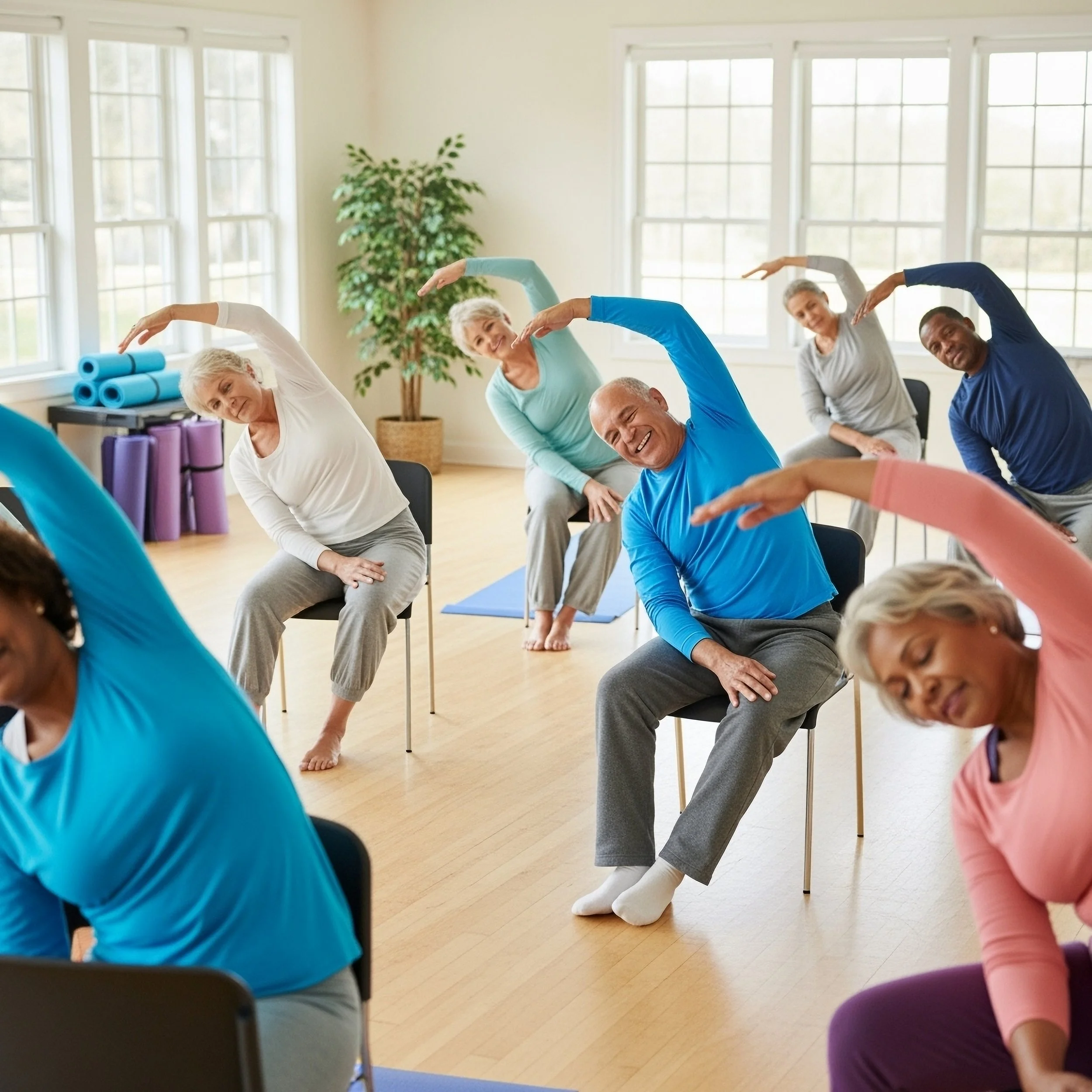
Chair Yoga for Seniors in Edmonton
Seated and gentle practice, taught one to one in your own home.
Chair Yoga for Seniors in Edmonton
Yoga you can do from a chair, at home.
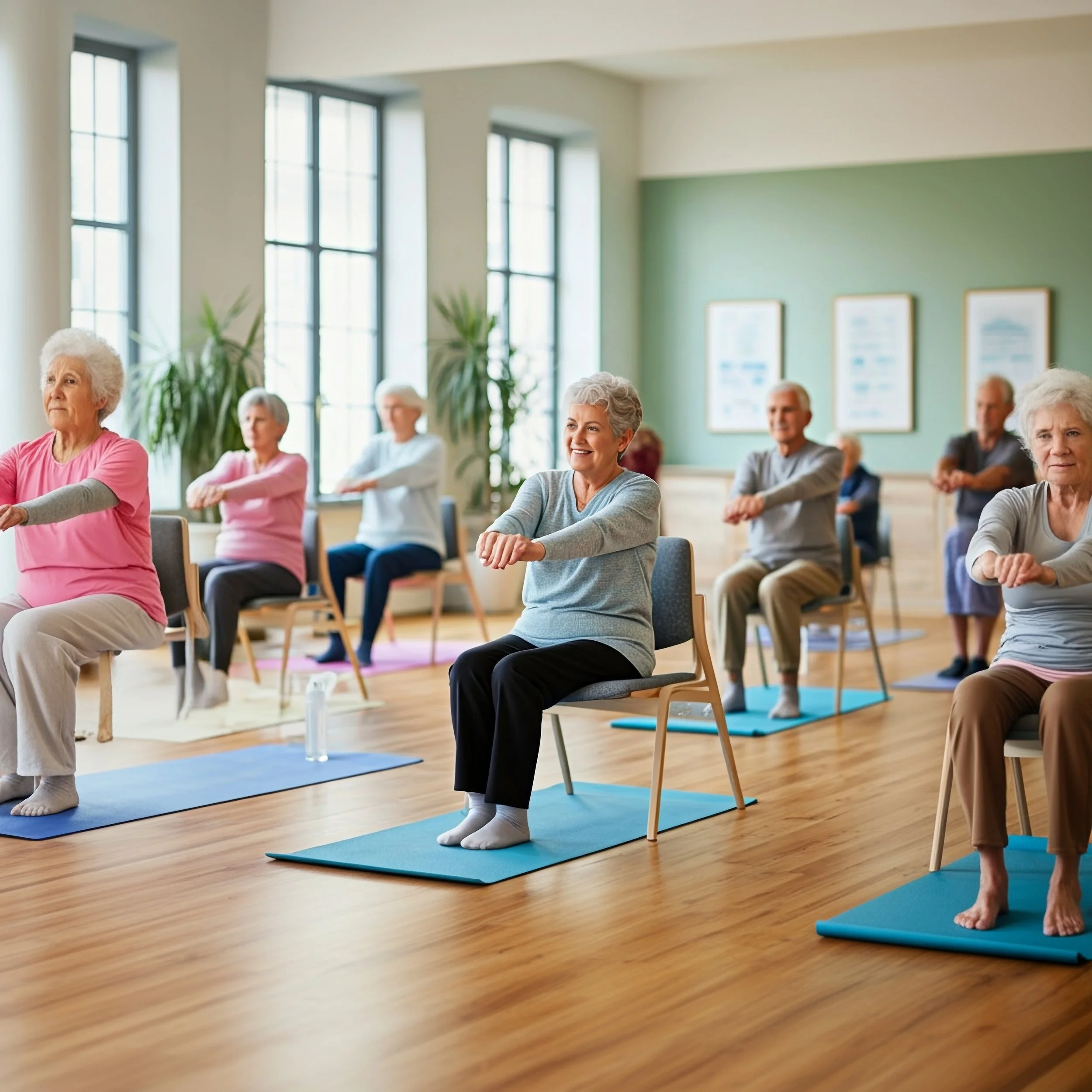
Chair yoga is a full practice done seated, or standing with a chair for support. Nothing requires getting down onto the floor and back up again, which is the single thing that rules most studio classes out for people who would otherwise be keen.
I teach it one to one, at your home, anywhere in Edmonton and the surrounding communities. No class to get to, no parking, no room of strangers, and no waiting for a session that fits your week. If getting somewhere is the thing that has been stopping you, that part is now solved.
This is not a watered-down version of a yoga class. It is a practice built for a body that has other priorities than putting a foot behind its head — balance you can rely on, joints that move through their range, and the strength to get out of a chair without thinking about it.
What we actually work on.
Four things, in roughly this order of priority, adjusted to whatever your situation calls for.
Balance and stability
The most important one, and the reason a lot of people start. We work standing balance with the chair there for support, then gradually with less of it. Falls are the single largest threat to independence in later life, and balance responds to training at any age.
Range of motion that you use
Shoulders that reach a high shelf. Hips and ankles that manage stairs and kerbs. A neck and spine that turn far enough to check a blind spot. Not flexibility for its own sake — the specific ranges that everyday life keeps asking for.
Strength through the movements that matter
Getting out of a chair, up from the floor if that is realistic, and carrying something in one hand without listing. These are trainable, they decline quickly when they are not trained, and gentle does not have to mean easy.
Breath, and the part where you settle
Slower breathing, and ten minutes at the end where nothing is required of you. This tends to be the part people mention afterwards, and it is a legitimate reason to do this on its own.
Arthritis, osteoporosis, and working around a diagnosis.
Most people I work with in this age group have something — arthritic hands or knees, a diagnosis of osteopenia or osteoporosis, a replaced joint, a back with a long history. That is closer to typical than unusual, and it is worked around rather than treated as a reason not to start.
What that means practically: you tell me what you have got and what anyone medical has said about it, and the session is built inside those limits. With osteoporosis, for instance, there are specific spinal movements I will avoid entirely, and I would rather know before we begin than discover it halfway through.
What I am not: a physiotherapist or any kind of medical practitioner. If what you are describing needs assessment or rehabilitation rather than training, I will say so and tell you to see one. Yoga can help a great deal with stiffness, balance and confidence. It is not treatment, and anyone selling it to you as treatment is overselling.
If you are looking on behalf of a parent.
You are a common visitor to this page, and the questions are usually the same: will it be safe, will they actually enjoy it, and will they keep going.
On safety — sessions are one to one, at their pace, and nothing happens without me knowing their history. On enjoyment — a lot depends on the person not feeling managed, which is why this is taught as yoga rather than as an exercise programme, and why the last ten minutes are just rest. On keeping going — coming to them removes the excuse that ends most attempts, and having a scheduled hour with a person is far stickier than a class they have to decide to attend.
You are welcome to be there for the first session, and plenty of people are. It is also fine to arrange and pay for it and then stay out of the way, which is often what works better.
What chair yoga will not do on its own.
It will improve your balance, your range of motion and how confident you feel moving. Those are real, and for many people they are the whole point.
What it will not do much of is build muscle or bone density — and after about sixty, both of those decline steadily unless something is actively done about them. That needs progressive resistance: real load, added gradually over time. It is the single most evidenced thing anyone your age can do for how the next twenty years go.
That is the other half of what I do, and it is designed for exactly this. Coached strength training for older adults, written around your joints and whatever equipment you have, at $180 a month. Plenty of people do the chair yoga and nothing else, which is a perfectly good place to land — but if you want the fuller picture, that is where it is.
What about chair Pilates?
The terms overlap heavily and most people searching for one would be happy with the other. Chair Pilates leans more towards core control and repeated precise movement; chair yoga leans more towards range of motion, breath and held positions. In a one-to-one session built around you, elements of both turn up regardless of what we call it.
If Pilates specifically is what you are after, I also teach mat-based Pilates fusion classes at Oxygen in Chappelle and Windermere — though those are floor-based and not chair-adapted.
Common questions.
-
No. Everything can be done seated or standing with the chair for support. If getting to the floor is something you want to work towards, we can — that is a genuine goal for some people — but nothing in a session requires it.
-
No. Most people I teach in this age group have never done any, and starting later has one real advantage: you have no habits to unlearn and no expectation of what your body used to do. Balance and strength both respond to training well into your eighties and beyond.
-
A sturdy chair without arms — a dining chair is ideal — and enough clear floor around it to stand and reach. That is all. I bring anything else.
-
Whatever you can move in comfortably. Bare feet or socks with grip. There is no need for anything special, and nothing about this requires the clothes people associate with a yoga studio.
-
It is worth doing, and the difference from stretching is that it is progressive — the balance work gets harder, the holds get longer, the support gets reduced. Stretching on its own does not build anything. A practice that gets incrementally more demanding does.
-
Weekly works well and is what most people settle into. Fortnightly is fine if you do a little on your own between sessions, and I will give you two or three things to practise. Less often than that keeps you ticking over rather than improving, which is a legitimate choice — I just want you to know which one you are choosing.
-
Yes, and usually at the same price. Two people in one house works well, and having someone else there makes the first session easier for a lot of people.
-
Yes. Small groups in a common room work well, and I am happy to talk to an activities coordinator about a regular session. Group sessions in a residence or care home are quoted per booking rather than charged at the private rate — the size of the group and how often you want me there both change the answer, so get in touch and we will work it out.
Start with a conversation.
Tell me roughly where you are in the city, what you are hoping to get out of it, and anything about your body or your history I should know before we begin. I will tell you honestly whether this is the right fit.