
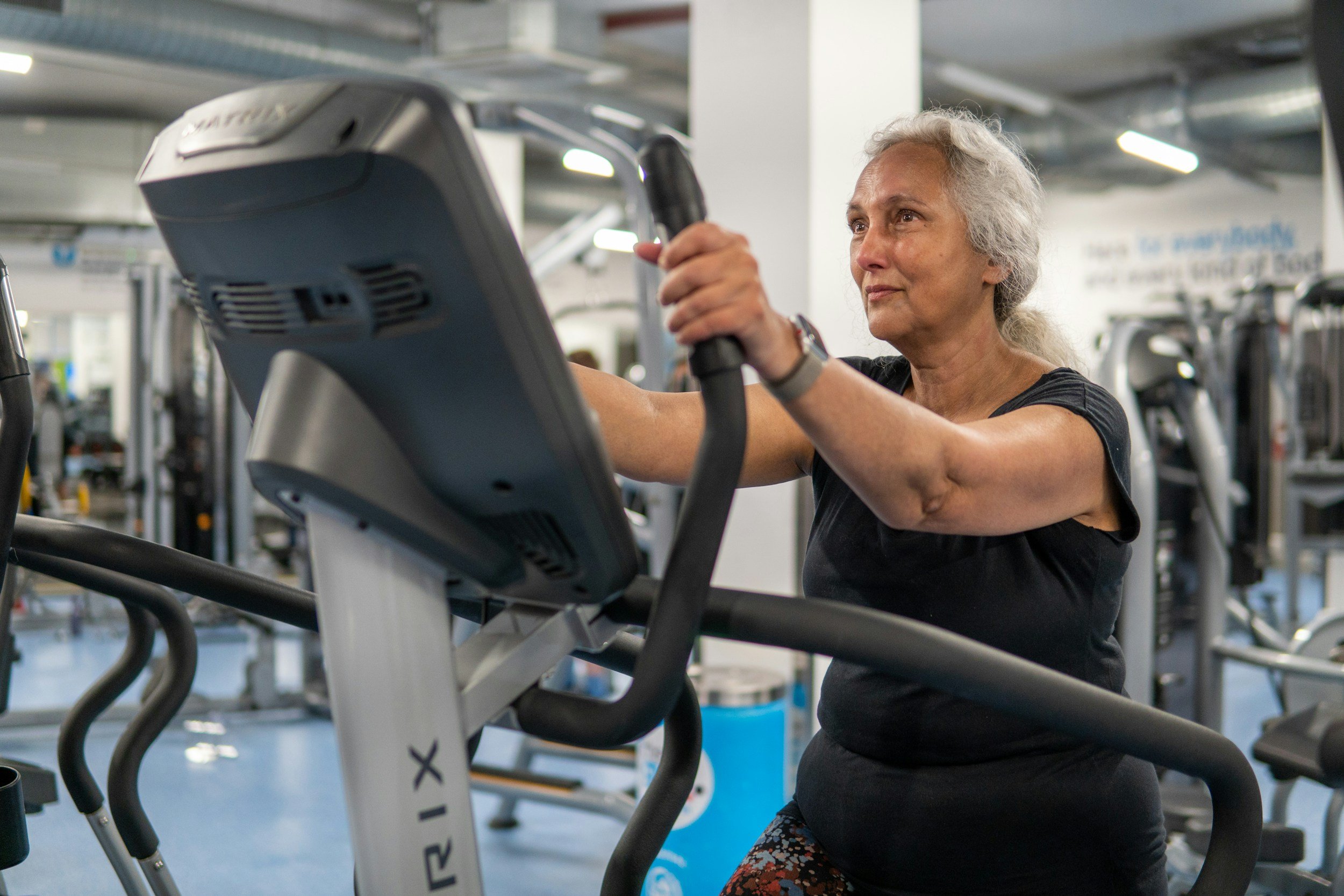
Online Strength Training for Older Adults, Anywhere in Canada
Get stronger for the stairs, the grandkids, and the next twenty years — with a program written for your body and a coach checking in every week.
Online Strength Training for Older Adults, Anywhere in Canada
● Programs written one at a time, around your joints, your history, and what your doctor has already told you.
● A coach who reads your logs every week and changes the plan — not an app that hands you the same workout as everyone else.
● Train at your gym, your community centre, or your basement, anywhere in Canada.
Strength training for older adults, coached one person at a time.
Strength training for older adults is resistance training programmed for a body with decades of history in it — the same lifts everyone else does, loaded and progressed differently. Done properly it builds muscle and strength at any age. I write you a program around your joints, your equipment and your week, then check in every week and change it as you go. It costs $180 a month, anywhere in Canada.
Most people who land here are asking one of two questions. Either “am I too old to start lifting?” — no — or “I know I should be lifting, but everything I find online is either a chair-band routine that does nothing or a program written for a 25-year-old.” That second problem is the real one, and it is the one coaching solves. The gap is not that the exercises are different at 68. It is that nobody is watching how your body responds and adjusting for it.
Why strength matters more after 60, not less.

Adults lose muscle steadily from midlife onward, and the losses accelerate with age unless something is done to interrupt them. That loss shows up long before anyone calls it a health problem: a handrail used on stairs that never needed one, a suitcase that suddenly needs help, a chair that takes two attempts. Resistance training is the most direct way to push back on it, and unlike most things worth doing at this age, the results arrive quickly enough to notice.
This is not a fringe position. Canada's national movement guidelines for adults aged 65 and older recommend “muscle strengthening activities using major muscle groups at least twice a week,” alongside 150 minutes of moderate-to-vigorous aerobic activity and “physical activities that challenge balance.” Most people over 60 are meeting the walking half of that and none of the strength half. Twice a week is the target; a written program is how it actually happens.
What that buys you, in the terms that matter: getting off the floor without planning the route, carrying groceries in one trip, keeping your balance when the sidewalk is uneven, staying in your own house longer. Strength is what turns those from things you hope you can still do into things you know you can.
How it works.
1. Start with a free consultation
A free 20-minute call, video or phone. We go through what you want to be able to do, what training you have done before — including none — what you can get to in the way of equipment, and how many days a week are realistic. Then the part that matters most at this age: your joints, your surgeries, your balance, anything that hurts, and anything a doctor or physiotherapist has already told you to do or avoid. If what you need is a physio rather than a coach, I will say so on that call.
2. Get a program built around your body
I write your program — the lifts, the sets, the reps, and a target weight or effort level for each one, laid out session by session in the app, with a demo video on every movement. It is built to the equipment you actually have and the days you actually train. If your knee does not like a deep squat, the plan says what you do instead; it does not leave you to work that out in the gym.
3. Check in every week and adjust
You log your sets as you go and send me a video whenever a lift feels wrong. Each week I read your logs, watch what you sent, and reply with what to change — more weight here, a different setup there, a lighter week when the numbers say you have earned one. That reply is the coaching. The program is just where it gets written down.
Everything lives in one private coaching app on your phone, built on the ABC Trainerize platform: your program, your demo videos, your logged weights, your check-ins and direct messages with me. If phone apps are not your favourite thing, I will walk you through it on the first call — it is four buttons, and most people are comfortable inside a week.
What is actually different about programming for an older adult.
Not the exercises. The loading, the pacing, and what gets prioritised. Here is what changes:
The lifts are chosen for what they give you back. Sit-to-stands and goblet squats for getting out of chairs. Hip hinges for picking things up off the floor. Step-ups for stairs and curbs. Loaded carries for groceries. Presses for the top shelf. Everything on the list has a job outside the gym.
Balance is trained on purpose, not hoped for. Single-leg work, carries, and controlled positions where you have to hold yourself steady — the national guidelines name balance as its own recommendation, so it gets programmed as its own thing rather than assumed to come along for the ride.
Progression is slower and never stalls. Loads climb in smaller steps and hold longer at each one. You still add weight — that is the whole point — but the jumps are sized so that tendons and joints keep up with muscle, which is the part most programs written for younger lifters get wrong for this reader.
Recovery is built into the plan. Tissue takes longer to bounce back at 65 than at 25, so the week is laid out with that in mind rather than treating soreness as evidence the session worked.
Mobility and breathing are part of the program. I teach yoga as well as lift, so hips, shoulders, ankles and breath get trained deliberately instead of being bolted on as a warm-up you skip. For this reader that is not a bonus — stiff ankles and locked-up hips are usually what is limiting the squat in the first place.
Your medical history sets the boundaries and I program inside them. Replaced hip, fused vertebrae, arthritic knees, a heart condition your cardiologist has given you activity limits for — tell me on the call and the plan is written to it. I am a coach, not a physiotherapist or a doctor: I do not diagnose, treat, or overrule anyone who is.
Why I coach older adults.
The honest answer is that they were some of my first clients, and they taught me more about coaching than anyone else has. I have taught yoga for years and older students have always been a real part of those classes — you learn quickly how differently a 70-year-old body warms up, what a hip that has been stiff for thirty years will and will not do, and how much of the work is talking someone out of the belief that they are too fragile to try. I have also coached older adults one to one in the gym, and I have trained my own family members, which is a category of client with strong opinions.
What I noticed across all of them is the same thing: they get stronger faster than they expect, and they are almost always undertrained rather than overtrained. Someone arrives convinced they should be careful, and the careful thing turns out to be lifting something meaningful, slowly, with somebody watching. The change usually shows up outside the gym first — the stairs, the garden, the grandchild who wants to be picked up.
I compete in powerlifting myself and my results are public on OpenPowerlifting. That matters here for one reason only: getting strong safely and progressively is the thing I have spent years learning to do to my own body, and the principles do not change with the age of the person. Only the dials do.
Simple pricing: $180 a month.
One plan, everything in it: your written program, weekly check-ins, video form review, every revision along the way, the app, and direct messaging with me. Month to month — no long contracts, no sign-up fee. Add nutrition coaching for $40 more and you are at $220 a month for both, which is $40 less than booking them separately.
Is lifting weights safe at 65, 70, or 80?
For most healthy older adults, yes — supervised strength training is widely recommended, including by Canada's national movement guidelines for adults 65 and older. The risk is rarely the lifting itself; it is loading too fast, or training around an injury nobody assessed. Start light, progress deliberately, and get medical clearance if you have a condition that warrants it.
And the part that costs me money: not everyone here needs to hire me. If you are already lifting twice a week and progressing, keep going. If you are recovering from a fall, a fracture or a surgery, you need a physiotherapist first and me afterwards — I will tell you that on the call rather than sell you a program you should not be running yet. Plenty of people book a consultation and leave with a suggestion and no invoice.
Questions people actually ask.
-
No. Muscle responds to training at every age that has been studied, including in people starting in their eighties and nineties. Starting later means the early progress is often more noticeable, not less, because you are further from your ceiling. What changes with age is how quickly you add weight and how much recovery gets planned in — not whether it works.
-
$180 a month, month to month. That covers your written program, weekly check-ins, video form review, and every revision along the way — there is no extra charge to rewrite your plan when something changes. Strength and nutrition coaching together is $220 a month.
-
Usually, yes — that combination is closer to typical than unusual for the people I write for. Tell me the details on the consultation call, including anything a doctor or physiotherapist has told you, and the program is built inside those limits. If your situation needs assessment or rehabilitation rather than training, I will say so and point you to a physiotherapist.
-
Either works. I write your program around the equipment you actually have — a commercial gym, a community centre, or a couple of adjustable dumbbells and a sturdy chair at home. Tell me what you have access to on the call and the plan is built to it, not to a gym you would have to join.
-
Heavier than most programs aimed at your age group would suggest, and lighter than you might fear. We start deliberately light while I see how you move, then add weight in small steps as your technique holds. The goal is real resistance — light enough to control, heavy enough to change something. Two-pound dumbbells will not make you stronger, and pretending otherwise wastes your time.
-
That is most of the people I start with. You begin with a handful of basic movements, each with a demo video, and you send one back so I can correct it before a habit sets in. The first few weeks are about learning the movements at a weight that feels easy — that is deliberate, and it is why the loading later works.
Ready when you are.
The consultation is free, takes 20 minutes, and ends with you knowing what a sensible first block of training looks like for you — whether or not I am the one writing it.